Missing person
Not Without HopeMissing person describes the uncertain condition that begins when Marquis Cooper, Nick Schuyler, Will Bleakley, and Corey Smith fail to return from a fishing trip and cannot be contacted. Their disappearance follows a specific chain of decisions offshore: the anchor remains stuck, the anchor line is moved to the stern, the motor is throttled forward, water pours into the boat, and the vessel capsizes. What makes the missing-person state decisive is the gap between the men’s actual struggle for survival and the incomplete, delayed picture available to everyone on shore.
From overdue boat to missing people
The crisis first appears through ordinary domestic concern. Paula Oliveira returned from a dance competition in Lakeland, Florida, fell asleep, and woke around 12:30 or 1:00 A.M. on Sunday, March 1, 2009, to find Nick Schuyler absent. Her call went directly to voice mail; Will Bleakley’s phone rang once and then also went to voice mail. At that moment, the men were not yet publicly defined as missing. They were simply late, unreachable, and separated from the routines that would normally make their whereabouts clear.
At 1:27 A.M., the St. Petersburg Coast Guard station received notice that a twenty-one-foot Everglades fishing boat was overdue. Brian Miller, a friend of Marquis Cooper, reported that the boat had left the Seminole Boat Ramp in Clearwater and was apparently headed toward a dive wreck fifty nautical miles west of Clearwater Pass. The initial report contained errors: it stated that there were two other passengers rather than three and described the passengers as having little maritime experience. The boat’s recent motor rebuild and Cooper’s limited maritime experience also shaped the Coast Guard’s early assessment. Because the vessel was far offshore, it lay beyond the range of the station’s communications towers, and repeated calls on VHF Channel Sixteen produced no response.
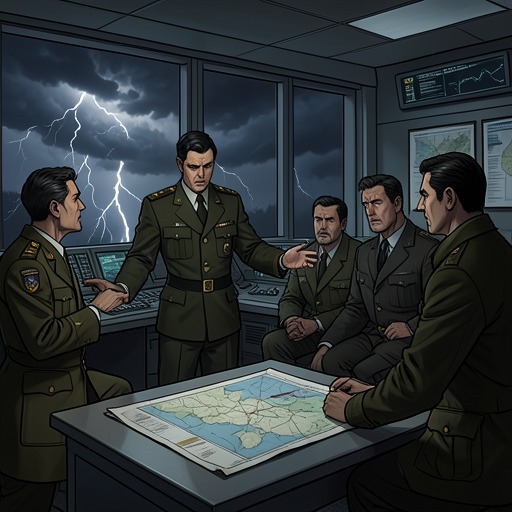
The Coast Guard did not immediately dispatch rescue craft merely because the boat was overdue. Operators first needed to establish the intended destination, expected return time, normal habits, distance from shore, fuel status, and departure point. The distinction between lateness and emergency therefore depended on accumulated evidence. At 2:37 A.M., seventy minutes after the vessel had been declared overdue, the case was upgraded from alert to distress. Rough weather, the men’s unprecedented failure to return from such a distant trip, the absence of contact for nearly twenty hours, and water temperatures of roughly sixty-four degrees made the possibility of a catastrophic outcome increasingly difficult to dismiss.
Why they were difficult to locate
The men’s missing-person status was intensified by uncertainty about both the vessel and its occupants. The Coast Guard did not know whether the boat remained upright, whether it had capsized, whether the fishermen were still aboard, or whether they had entered the water and stayed with the hull. A drifting boat could be moved more by wind, while people in the water would be affected more directly by current; wind and current might carry them together or pull them apart. A search program therefore had to calculate probabilities rather than begin with a confirmed position.
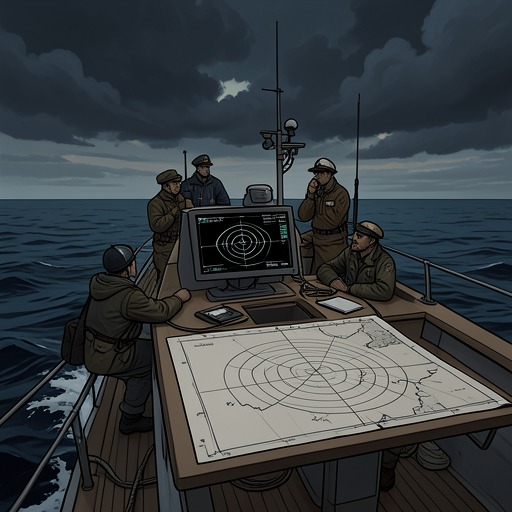
Visibility and equipment compounded the uncertainty. If the boat had overturned but remained afloat, searchers might see only a small portion of its white hull among hundreds of thousands of whitecaps. The moon offered little help, and storm clouds from a cold front suppressed what light there was. The boat had no emergency position-indicating radio beacon, a device that could have transmitted its identity and location automatically or manually after a capsize. Captain Timothy Close’s distinction was stark: with such a beacon, the situation would have been a rescue rather than a search. The absence of that equipment did not establish that the men had acted foolishly, but it left rescuers without the precise signal that could have transformed the problem.
A handheld GPS device belonging to Marquis Cooper eventually supplied coordinates, but those coordinates were not the boat’s confirmed location. They indicated a customary fishing position about ten miles south of the plotted wreck site, enlarging rather than resolving the search area. The Coast Guard transmitted the adjusted position to a C-130 Hercules aircraft, but the search system itself encountered failures. One available aircraft developed engine trouble and never launched; a second finally departed at 3:00 A.M., flying at 1,000 feet and 140 miles per hour, only to experience radar problems over seas running roughly eight feet. Radar could suppress small waves as sea clutter, yet doing so in eight- to ten-foot seas risked suppressing the very scale of object the aircraft needed to find.
The physical event behind the disappearance
The later reconstruction shows that the men’s absence was caused by a rapid mechanical reversal, not by a simple failure to return. Marquis Cooper was driving while Nick Schuyler sat beside him on the captain’s bench. The boat was about one hundred yards downwind from the anchor. After Will Bleakley and Corey Smith failed to pull the anchor free, Cooper maneuvered around it for half an hour while the two strong, fit men hauled the line from different directions. The anchor remained fixed, possibly in a shipwreck, cable, debris, or mud roughly 150 feet below.
The decision to move the one-inch anchor line from the bow to a stern cleat converted a stuck anchor into a danger attached to the back of the vessel. When Cooper tightened the line and gunned the motor, the anchor blades apparently dug in more deeply. The stern squatted, water poured into the boat, the bow lifted, and the vessel listed toward port. The men had no time to make a Mayday call. Nick Schuyler escaped as the boat rolled, entering water that was dramatically different from the familiar experience of falling from a Jet Ski near the shore of Lake Erie: this was a 3,400-pound boat overturning amid seven-foot swells in the Gulf of Mexico.
Cutting the rope around the propeller raised the stern slightly and allowed the boat to drift, but it did not restore the men’s control. They tried to flip the hull by lying across the stern, kicking downward, pulling with their arms, and pushing from the starboard side. The submerged center console acted as a resistant rudder, leaving no leverage. Their combined strength could not bring the boat even close to upright. The later Florida Fish and Wildlife Conservation Commission investigation identified three causal factors: improper attachment of the anchor line to an eye bracket on the port side of the transom, throttling forward in an attempt to free the anchor, and failure to leave enough slack, which caused the stern to submerge and the boat to capsize.
Search, information, and public recognition
The search widened as officials tried to correct the incomplete account. At 6:38 A.M., Coast Guard personnel suggested checking the missing men’s credit-card activity and searching closer to shore, since inexperienced boaters might have changed plans and remained within sight of land. They also considered informing the media early so people on land and water could watch for signs of the boat. The advice reveals how missing-person cases are built from competing possibilities: the men might have stayed near shore, continued offshore, suffered mechanical trouble, or been thrown into the sea.
After sunrise, a Jayhawk helicopter was launched at 7:09 A.M. and reached the search area at 7:45. A forty-seven-foot motor lifeboat arrived at the supplied GPS coordinates at 7:10, facing seas of eight to ten feet, occasional waves as high as twelve feet, thirty-mile-per-hour winds, and visibility of only half a mile. The conditions were so severe that Captain Timothy Close compared the lifeboat’s journey to an E-ticket ride at Disney World. The rescue effort was therefore constrained by the same environment that had made the fishermen disappear: the Gulf concealed the boat, disrupted radar, reduced visibility, and endangered the rescuers themselves.
The human dimensions of the missing-person state expanded through family contact. Paula Oliveira went to St. Paul’s Catholic Church in Tampa, despite not practicing her childhood faith, and prayed for Nick, Will, Marquis, and Corey to come home safely. Later that morning, the Coast Guard advised her that she might need to inform Nick’s family because the media would be alerted. Before 11:00 A.M., officials confirmed that four men were missing rather than three and that two were NFL players. Their athletic identities increased public attention, but the correction also exposed how quickly a disappearance can be distorted by incomplete reporting: even the number of people aboard was initially wrong.
Consequences and retrospective responsibility
The missing-person state carried a biological threat as well as an investigative one. If the men had been thrown into the Gulf, swallowing seawater could have produced a dangerous sodium imbalance, drawn water from cells, caused delirium and seizures, and progressed to heart failure and death through dehydration. Cold water, darkness, rough seas, limited communication, and the boat’s lack of an emergency beacon all narrowed the time available for rescue. The men’s disappearance was thus a moving physiological emergency, even while the people on shore were still assembling the facts.
Later knowledge did not erase the uncertainty experienced during the search; it gave that uncertainty a painful shape. Nick Schuyler eventually had to explain to Will Bleakley’s parents what had happened. They asked whether the men had been drinking and questioned the decision to put the anchor line at the back of the boat. Schuyler answered that alcohol was not the reason for the accident. The evidence records that Corey Smith did not drink, Schuyler had consumed only a beer and a half and vomited it, Will had consumed seven or eight beers, and Cooper five or six over ten hours; the men appeared generally clearheaded. Their decisions can therefore be examined as factors in a chain of risk without reducing the disappearance to intoxication or assigning a single moral cause.
Schuyler’s later reflections show how the missing-person state persists after physical certainty is achieved. He wished the men had prepared better to send a distress signal, marked their exact destination, carried more flares and flashlights, and worn life jackets or known where they were stored. He also returned to the anchor decision and to the possibility that his illness had prevented him from recognizing the danger. Questions about lending Will a jacket, changing a choice, or acting sooner could not produce a different outcome; they became part of survivor guilt rather than a usable reconstruction of the past. In this way, “missing” names not only the period before the men are found or accounted for, but also the emotional uncertainty left behind when explanations arrive too late.